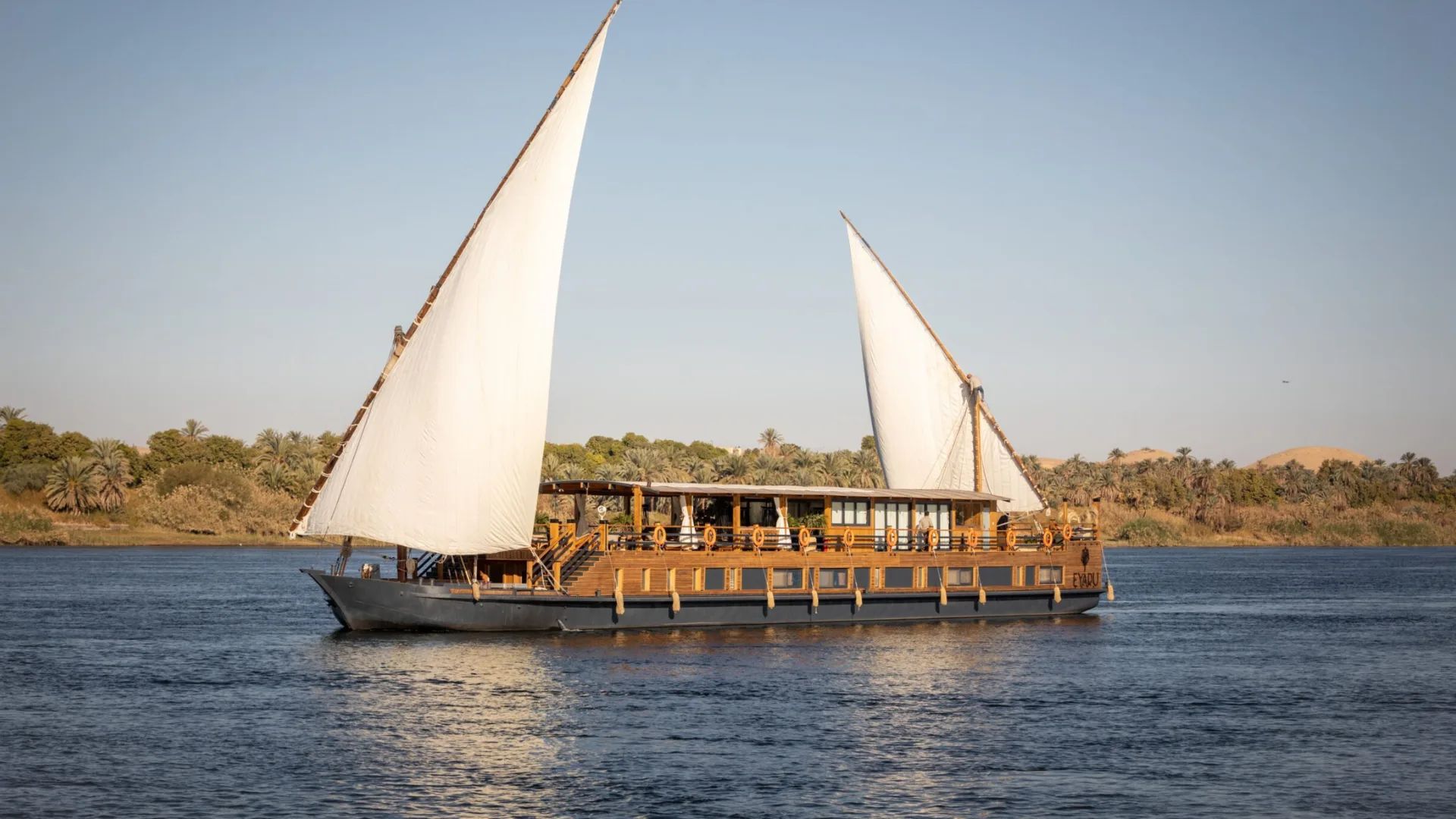

In the morning, your private transfer will meet you at your Luxor hotel or airport to begin your Dahabiya Nile cruise to Aswan. Joined by your expert Egyptologist guide, you will set out to discover Luxor's most iconic monuments:
 Valley of the Kings
Throughout the New Kingdom (1550–1070 BCE), pharaohs and royals of the 18th, 19th, and 20th Dynasties chose the Valley of the Kings as their final resting place within the sacred heart of the Theban Necropolis. Carved deep underground beneath a natural pyramid-shaped peak lie 63 rock-cut tombs—including those of Tutankhamun and Ramesses the Great. Adorned with vibrant wall reliefs and sacred texts, these subterranean crypts preserve extraordinary insights into ancient Egyptian mythology, funerary arts, and eternal beliefs.
 Hatshepsut Temple
Commissioned in the 15th century BCE, the Mortuary Temple of Queen Hatshepsut stands as one of the finest masterpieces of New Kingdom classical architecture. Designed across three sweeping terraced levels by the royal architect Senenmut, this colossal sanctuary seamlessly integrates into the sheer cliffs of Deir el-Bahari and served as a dedicated center for the worship of Amun.
 Colossi of Memnon
Commissioned by Pharaoh Amenhotep III around 1350 BCE, the twin quartzite monuments known as the Colossi of Memnon were built to stand guard at the entrance of his vast mortuary temple. Though the surrounding sanctuary has largely dissolved into history, these 18-meter-tall guardians endure as symbols of pharaonic power and grace. During the Greco-Roman era (20–250 CE), the statues gained worldwide fame among travelers who journeyed to hear the famous acoustic "singing" phenomenon associated with the mythical hero Memnon.
After that, enjoy your lunch onboard the Dahabiya cruise, then escort your guide to visit:
 Karnak Temple
Dedicated to the Theban triad of Amun-Re, Mut, and Khonsu alongside various other deities, the monumental complex of Karnak stands as an architectural wonder at the heart of ancient Thebes. Built and expanded over two millennia—from roughly 1971 BCE down to 30 CE—this sprawling sanctuary represents the pinnacle of pharaonic engineering. Among its breathtaking masterpieces are the soaring columns of the Grand Hypostyle Hall and the majestic Avenue of Sphinxes.